Machine Learning and Data Mining (Module 2)

Matteo Francia
DISI — University of Bologna
m.francia@unibo.it

Open In Colab

The California Housing case study

Our task is to use California census data to forecast housing prices given the population, median income, and median housing price for each block group in California. Block groups are the smallest geographical unit for which the US Census Bureau publishes sample data (a block group typically has a population of 600 to 3,000 people). We will just call them “districts” for short.

Code
import pandas as pd

# df = pd.read_csv("/content/sample_data/california_housing_train.csv", delimiter=",")
df = pd.read_csv("https://raw.githubusercontent.com/w4bo/handsOnDataPipelines/main/materials/datasets/housing.csv", delimiter=",")
df
longitude latitude housing_median_age total_rooms total_bedrooms population households median_income median_house_value ocean_proximity
0 -122.23 37.88 41.0 880.0 129.0 322.0 126.0 8.3252 452600.0 NEAR BAY
1 -122.22 37.86 21.0 7099.0 1106.0 2401.0 1138.0 8.3014 358500.0 NEAR BAY
2 -122.24 37.85 52.0 1467.0 190.0 496.0 177.0 7.2574 352100.0 NEAR BAY
3 -122.25 37.85 52.0 1274.0 235.0 558.0 219.0 5.6431 341300.0 NEAR BAY
4 -122.25 37.85 52.0 1627.0 280.0 565.0 259.0 3.8462 342200.0 NEAR BAY
... ... ... ... ... ... ... ... ... ... ...
20635 -121.09 39.48 25.0 1665.0 374.0 845.0 330.0 1.5603 78100.0 INLAND
20636 -121.21 39.49 18.0 697.0 150.0 356.0 114.0 2.5568 77100.0 INLAND
20637 -121.22 39.43 17.0 2254.0 485.0 1007.0 433.0 1.7000 92300.0 INLAND
20638 -121.32 39.43 18.0 1860.0 409.0 741.0 349.0 1.8672 84700.0 INLAND
20639 -121.24 39.37 16.0 2785.0 616.0 1387.0 530.0 2.3886 89400.0 INLAND

20640 rows × 10 columns

… and now?

Answer some questions:

  • Which attributes (i.e., columns) are contained in the dataset?
  • Which is their semantics?
Code
df.columns
Index(['longitude', 'latitude', 'housing_median_age', 'total_rooms',
       'total_bedrooms', 'population', 'households', 'median_income',
       'median_house_value', 'ocean_proximity'],
      dtype='object')

Dataset description

  1. longitude: A measure of how far west a house is; a higher value is farther west
  2. latitude: A measure of how far north a house is; a higher value is farther north
  3. housingMedianAge: Median age of a house within a block; a lower number is a newer building
  4. totalRooms: Total number of rooms within a block
  5. totalBedrooms: Total number of bedrooms within a block
  6. population: Total number of people residing within a block
  7. households: Total number of households, a group of people residing within a home unit, for a block
  8. medianIncome: Median income for households within a block of houses (measured in tens of thousands of US Dollars)
  9. medianHouseValue: Median house value for households within a block (measured in US Dollars)
  10. oceanProximity: Location of the house w.r.t ocean/sea

Data profiling

Code
# show some statistics on the dataframe
df.info()
<class 'pandas.core.frame.DataFrame'>
RangeIndex: 20640 entries, 0 to 20639
Data columns (total 10 columns):
 #   Column              Non-Null Count  Dtype  
---  ------              --------------  -----  
 0   longitude           20640 non-null  float64
 1   latitude            20640 non-null  float64
 2   housing_median_age  20640 non-null  float64
 3   total_rooms         20640 non-null  float64
 4   total_bedrooms      20433 non-null  float64
 5   population          20640 non-null  float64
 6   households          20640 non-null  float64
 7   median_income       20640 non-null  float64
 8   median_house_value  20640 non-null  float64
 9   ocean_proximity     20640 non-null  object 
dtypes: float64(9), object(1)
memory usage: 1.6+ MB

Data profiling

Code
df.describe(include='all')
longitude latitude housing_median_age total_rooms total_bedrooms population households median_income median_house_value ocean_proximity
count 20640.000000 20640.000000 20640.000000 20640.000000 20433.000000 20640.000000 20640.000000 20640.000000 20640.000000 20640
unique NaN NaN NaN NaN NaN NaN NaN NaN NaN 5
top NaN NaN NaN NaN NaN NaN NaN NaN NaN <1H OCEAN
freq NaN NaN NaN NaN NaN NaN NaN NaN NaN 9136
mean -119.569704 35.631861 28.639486 2635.763081 537.870553 1425.476744 499.539680 3.870671 206855.816909 NaN
std 2.003532 2.135952 12.585558 2181.615252 421.385070 1132.462122 382.329753 1.899822 115395.615874 NaN
min -124.350000 32.540000 1.000000 2.000000 1.000000 3.000000 1.000000 0.499900 14999.000000 NaN
25% -121.800000 33.930000 18.000000 1447.750000 296.000000 787.000000 280.000000 2.563400 119600.000000 NaN
50% -118.490000 34.260000 29.000000 2127.000000 435.000000 1166.000000 409.000000 3.534800 179700.000000 NaN
75% -118.010000 37.710000 37.000000 3148.000000 647.000000 1725.000000 605.000000 4.743250 264725.000000 NaN
max -114.310000 41.950000 52.000000 39320.000000 6445.000000 35682.000000 6082.000000 15.000100 500001.000000 NaN

… are you satisfied with the understanding?

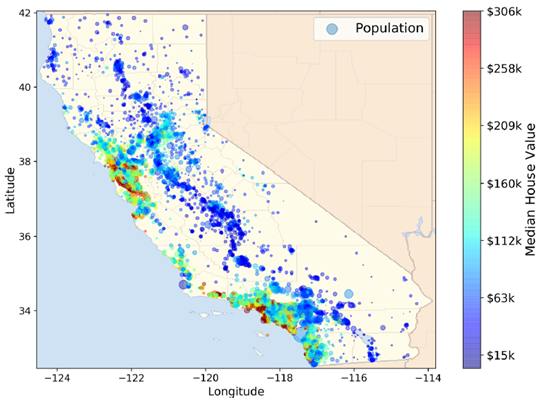
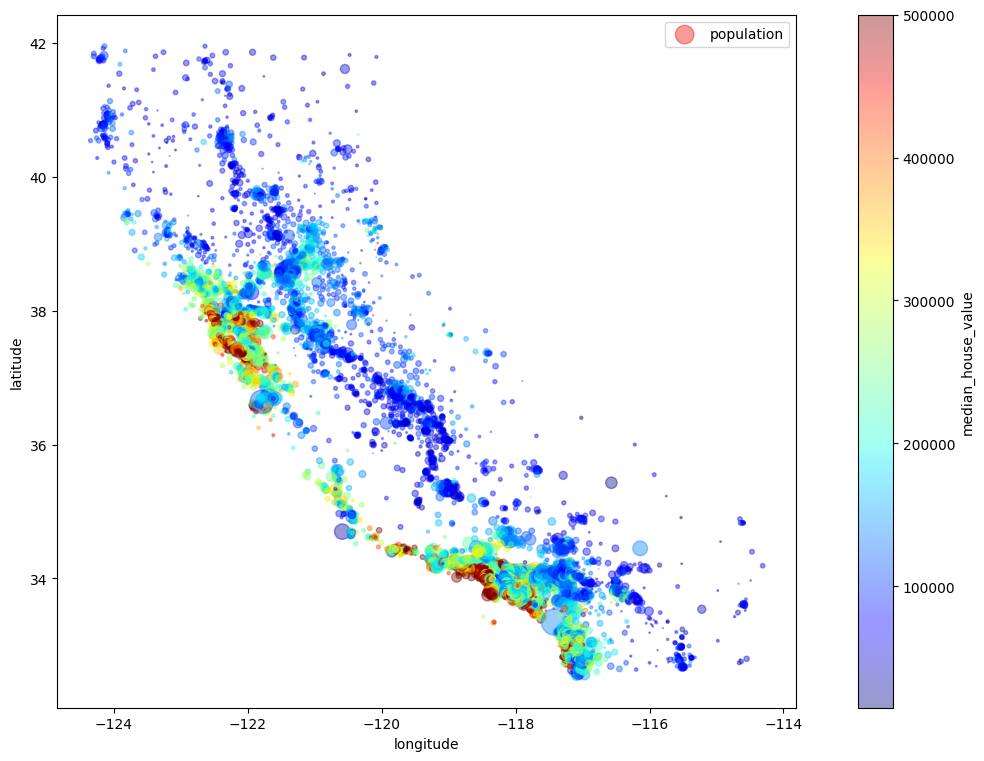
… what about data visualization?

Can we exploit the nature of the data?

Code
ax = df.plot(kind="scatter", x="longitude", y="latitude", alpha=0.4, s=df["population"] / 100, label="population", figsize=(16, 9), c="median_house_value", cmap="jet", colorbar=True)
ax.set_aspect('equal', adjustable='box')

What if we integrate open data?

Can we exploit the nature of the data… again?

California, USA

Merging the data sources

California, USA

Non-numeric attributes

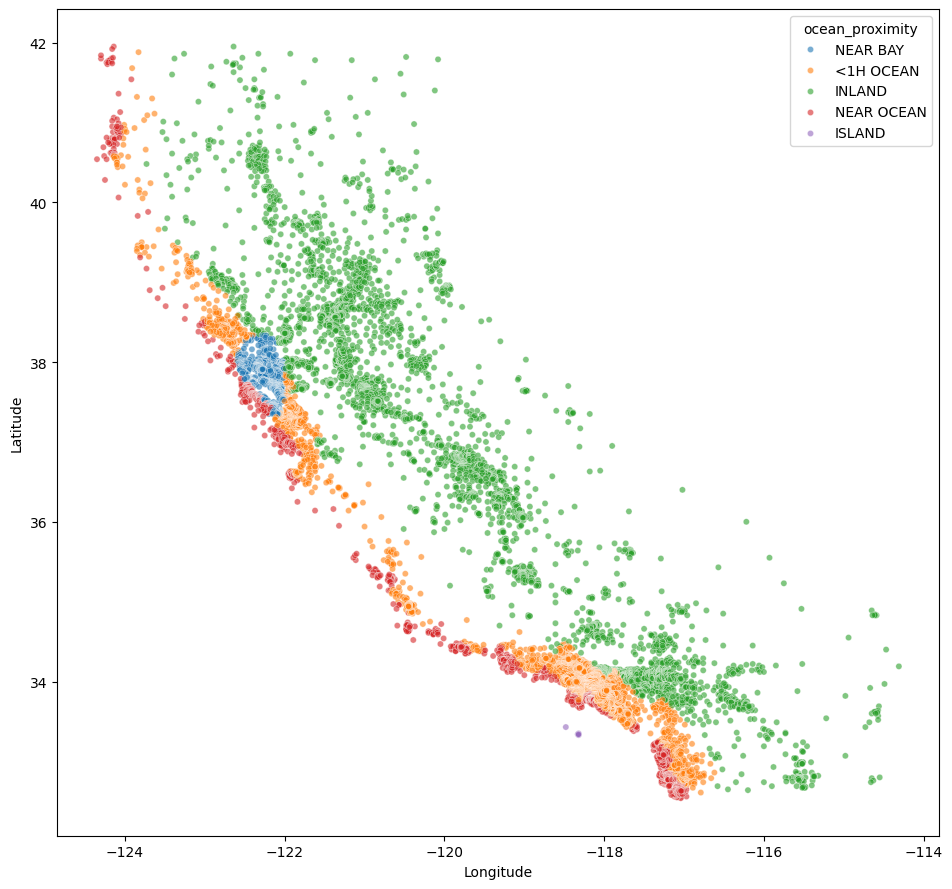
ocean_proximity is a text attribute, but not all machine libraries can manipulated textual data types.

Code
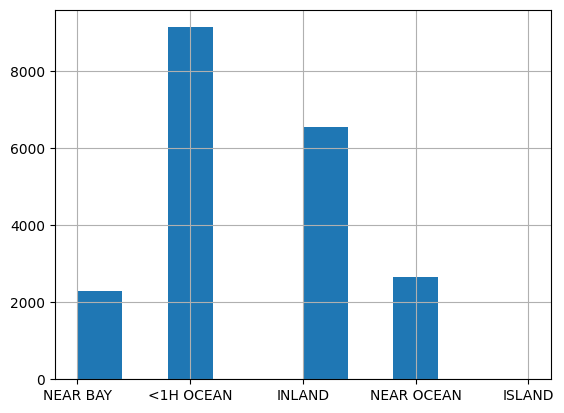
df["ocean_proximity"].value_counts()
count
ocean_proximity
<1H OCEAN 9136
INLAND 6551
NEAR OCEAN 2658
NEAR BAY 2290
ISLAND 5

Code
df["ocean_proximity"].hist()

Code
import seaborn as sns
import matplotlib.pyplot as plt

plt.figure(figsize=(16, 9))
sns.scatterplot(data=df, x="longitude", y="latitude", hue="ocean_proximity", alpha=0.6, s=20)
plt.gca().set_aspect('equal', adjustable='box')
plt.xlabel("Longitude")
plt.ylabel("Latitude")
plt.tight_layout()

Missing values

There are some missing values for total_bedrooms. What should we do?

Most Machine Learning algorithms cannot work with missing features.

Memory usage

What if I change float64 to float32?

Code
dff = df.copy(deep=True)  # copy the dataframe
for x in df.columns:  # iterate over the columns
    if dff[x].dtype == 'float64':  # if the column has type `float64`
        dff[x] = dff[x].astype('float32')  # ... change it to `float32`
dff.info()  # show some statistics on the dataframe
<class 'pandas.core.frame.DataFrame'>
RangeIndex: 20640 entries, 0 to 20639
Data columns (total 10 columns):
 #   Column              Non-Null Count  Dtype  
---  ------              --------------  -----  
 0   longitude           20640 non-null  float32
 1   latitude            20640 non-null  float32
 2   housing_median_age  20640 non-null  float32
 3   total_rooms         20640 non-null  float32
 4   total_bedrooms      20433 non-null  float32
 5   population          20640 non-null  float32
 6   households          20640 non-null  float32
 7   median_income       20640 non-null  float32
 8   median_house_value  20640 non-null  float32
 9   ocean_proximity     20640 non-null  object 
dtypes: float32(9), object(1)
memory usage: 887.0+ KB

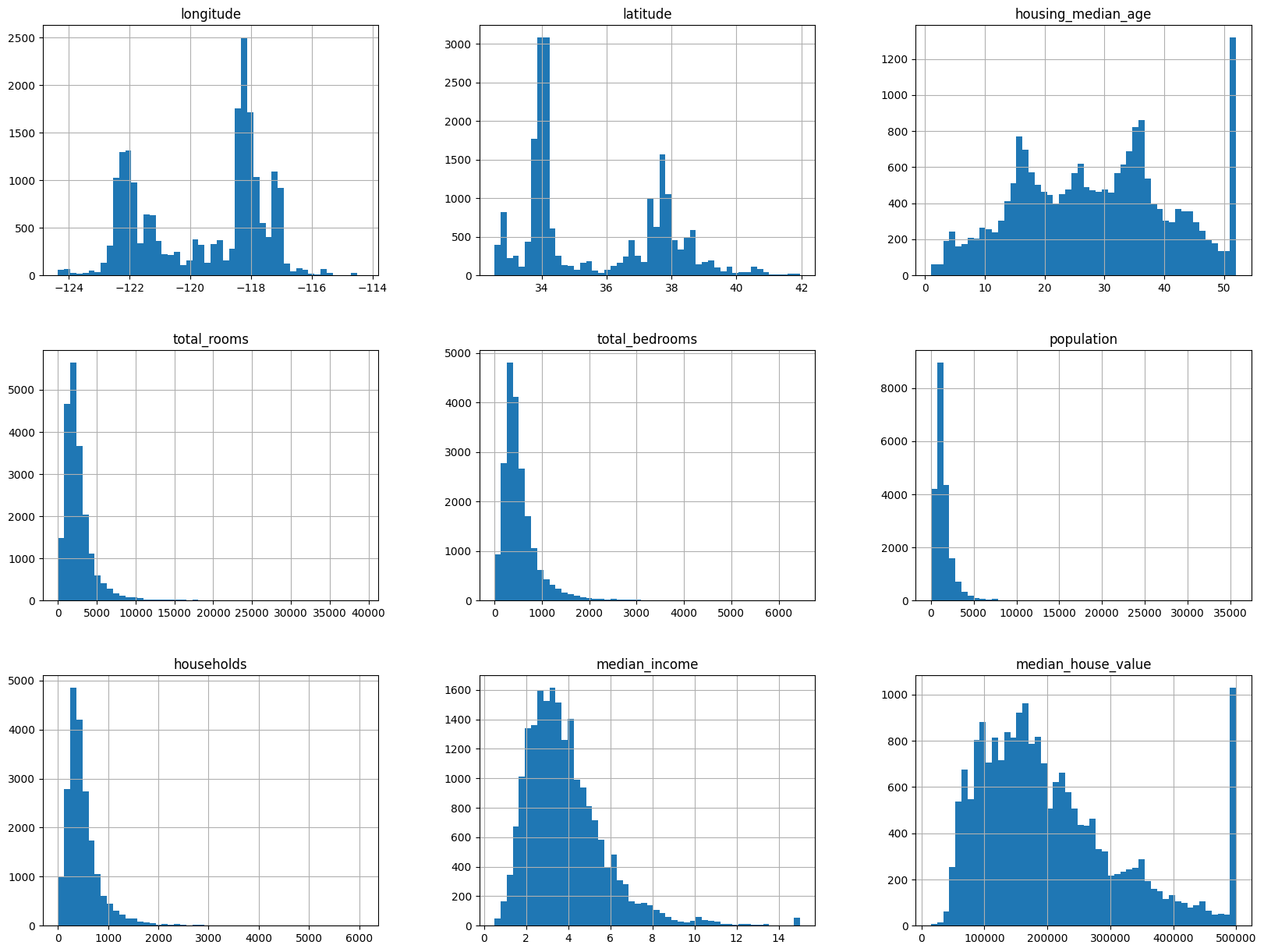
Visualization

Code
import matplotlib.pyplot as plt
%matplotlib inline
df.hist(bins=50, figsize=(20, 15))
plt.show()

Open questions

  • median_income should be in dollars. However, it has a strange range. Why? “you are told that the data has been scaled and capped at 15 (actually 15.0001) for higher median incomes, and at 0.5 (actually 0.4999) for lower median incomes. The numbers represent roughly tens of thousands of dollars. The numbers represent roughly tens of thousands of dollars”
  • housing_median_age and median_house_value are capped. As to median_house_value, this is a serious problem since it is your target attribute (your labels). Your Machine Learning algorithms may learn that prices never go beyond that limit. You need to check with your client team (the team that will use your system’s output) to see if this is a problem or not. If they tell you that they need precise predictions even beyond 500,000USD, then you have mainly two options: (a) collect proper labels for the districts whose labels were capped, (b) remove those districts from the training set.”
  • These attributes have very different scales. Should we scale them?
  • Many histograms are tail heavy: they extend much farther to the right of the median than to the left. This may make it a bit harder for some Machine Learning algorithms to detect patterns

Relationships between variables

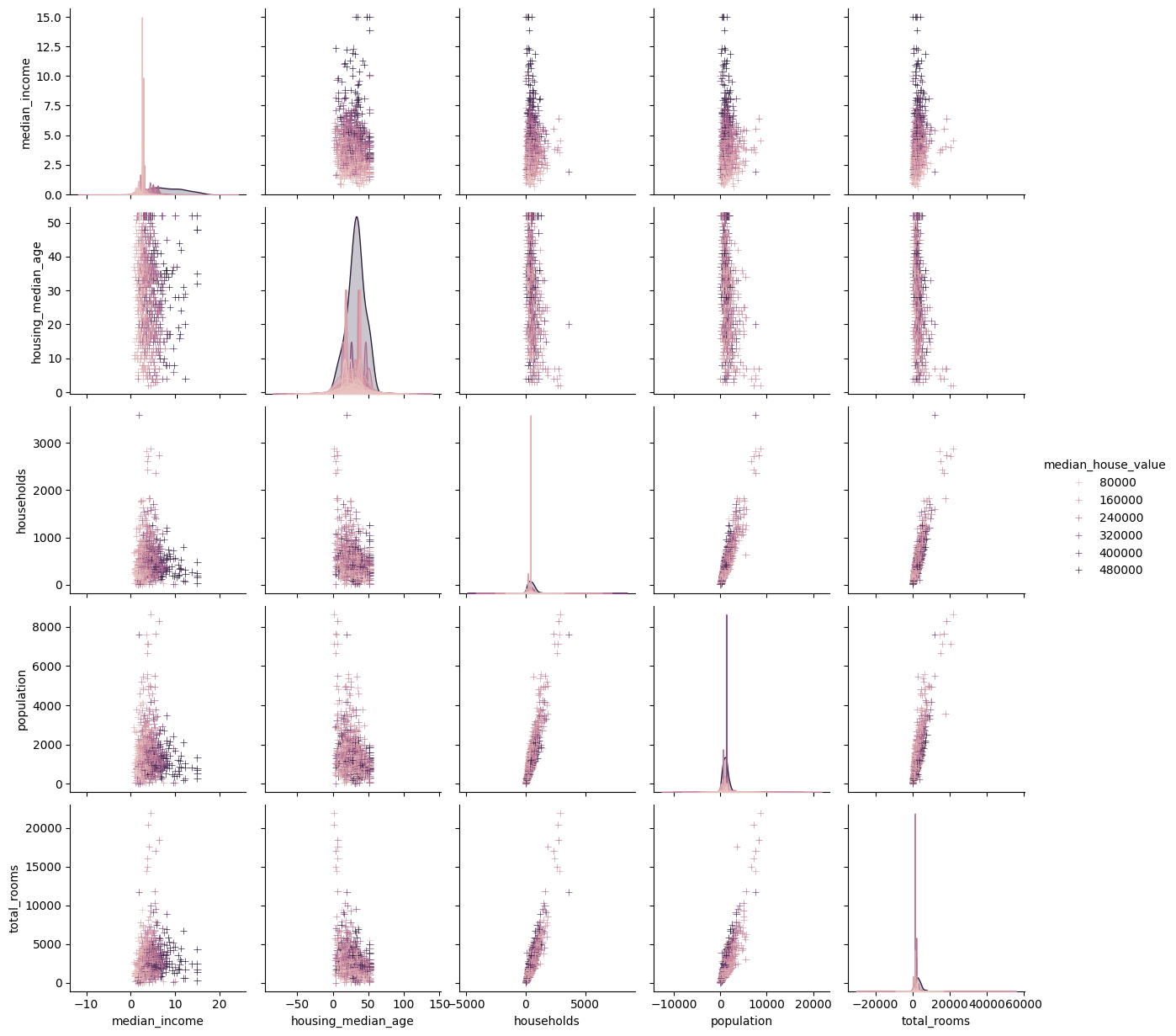
  • Each numeric variable in data will by shared across the y-axes across a single row and the x-axes across a single column
  • The diagonal plots are treated differently: univariate distribution plots show the marginal distributions of the data
Code
import seaborn as sns

tmp = df[["median_income", "housing_median_age", "median_house_value", "households", "population", "total_rooms"]]
sns.pairplot(tmp.sample(n=1000, random_state=42), hue='median_house_value', markers='+')
plt.show()

Code
import numpy as np

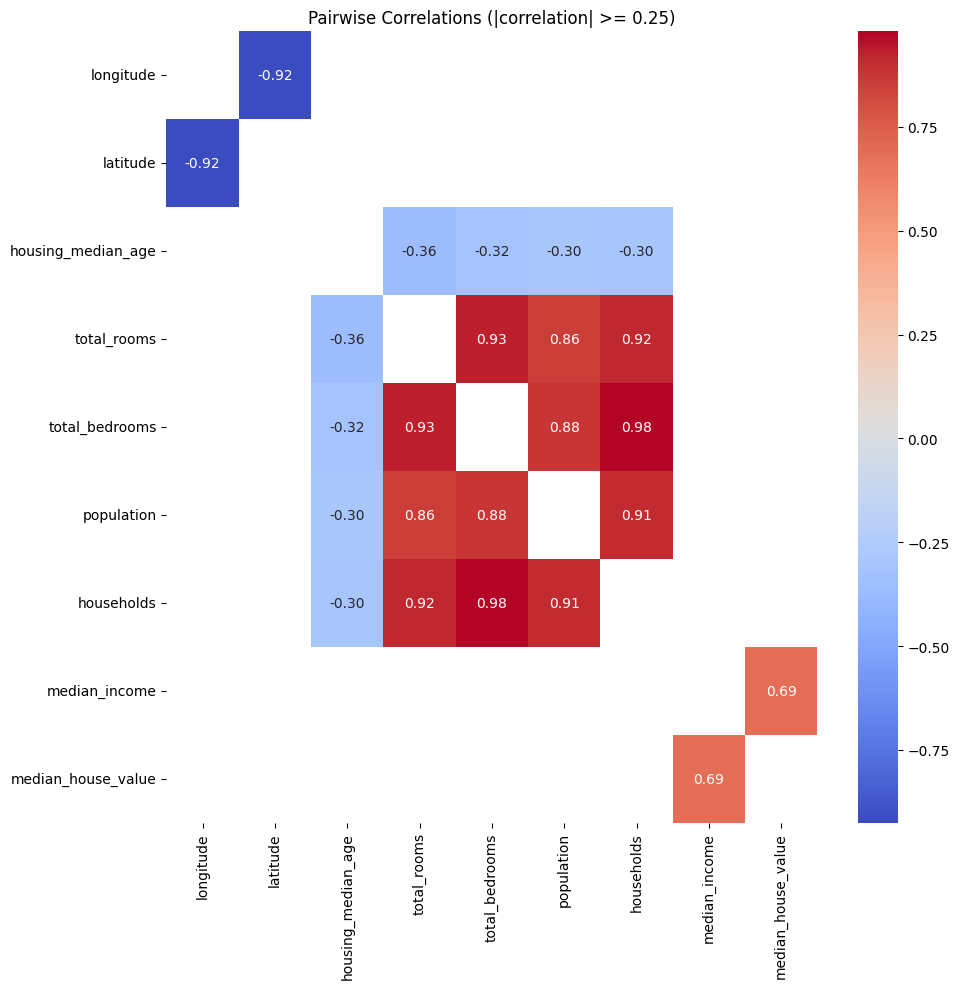
correlation_matrix = df.select_dtypes(include=['number']).corr()  # Compute the correlation matrix only on numerical features
filtered_correlation_matrix = correlation_matrix[correlation_matrix.abs() >= 0.25]  # Mask correlations with absolute values below 0.25
filtered_correlation_matrix[np.eye(filtered_correlation_matrix.shape[0], dtype=bool)] = np.nan  # Mask the diagonal
plt.figure(figsize=(10, 10))
sns.heatmap(filtered_correlation_matrix, annot=True, fmt=".2f", cmap="coolwarm", cbar=True)
plt.title("Pairwise Correlations (|correlation| >= 0.25)")
plt.tight_layout()

Pareto frontier

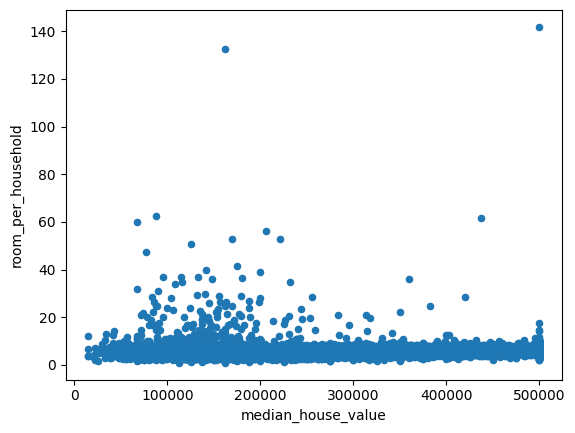
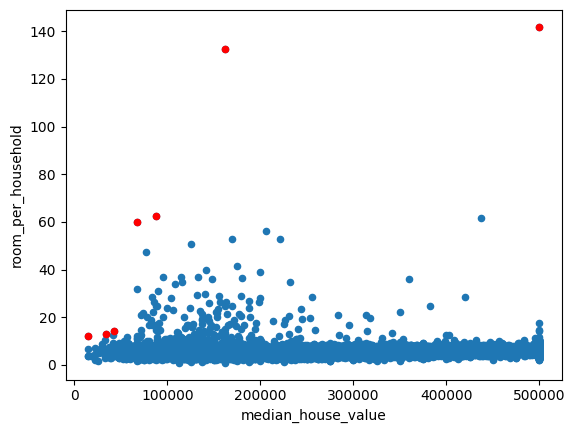
Which blocks represent a good tradeof between cost and number of rooms?

Code
fig, ax = plt.subplots(nrows=1, ncols=1)
df["room_per_household"] = df["total_rooms"] / df["households"]
df.plot.scatter(x='median_house_value', y='room_per_household', ax=ax)

Skyline

The skyline operator: optimization problem that computes the Pareto optimum on tuples with multiple dimensions

  • Skyline comes from the view on Manhattan from the Hudson River. A building is visible if it is not dominated by a building that is taller or closer to the river (two dimensions, distance to the river minimized, height maximized).
  • Users want hotels for a holidays to be cheap and close to the beach. However, hotels that are close to the beach are expensive.

Formally, a tuple dominates another if it is at least as good in all dimensions and better in at least one dimension.

NY Skyline

Pareto frontier

Code
from paretoset import paretoset

mask = paretoset(df[["median_house_value", "room_per_household"]], sense=["min", "max"])
df[mask].plot.scatter(x='median_house_value', y='room_per_household', ax=ax, c='red')
fig

Exercise 1

  1. For each ocean_proximity, return the number of blocks
  2. Return the ocean_proximity with the highest number of blocks
  3. Print the mean value per ocean_proximity for every column
  4. Print the mean, min and max values value per ocean_proximity for every column
Code
# Write your code here

Exercise 2

  1. Add a new column: population_per_household = population / households
  2. Add a new column: rooms_per_household = total_rooms / households
  3. Add a new column: bedrooms_per_room = total_bedrooms / total_rooms
Code
# Write your code here

Exercise 3

Complete the prediction pipeline with data preprocessing and machine learning algorithms.

To help you, you can follow these steps:

  • Set the random seed to enable reproducibility
  • Feature pre-processing (e.g., remove useless features, impute missing values, encode some features)
  • Check pairwise correlations among features
  • Split training and test data. When splitting train and test datasets, the test dataset should contain 30% of the data.
  • Plot the training dataset in 2D, are the outcomes well-separated?
  • Train at least two ML classification models
  • Perform hyperparameter optimization for at least one model
  • Identify the most relevant features in the prediction